
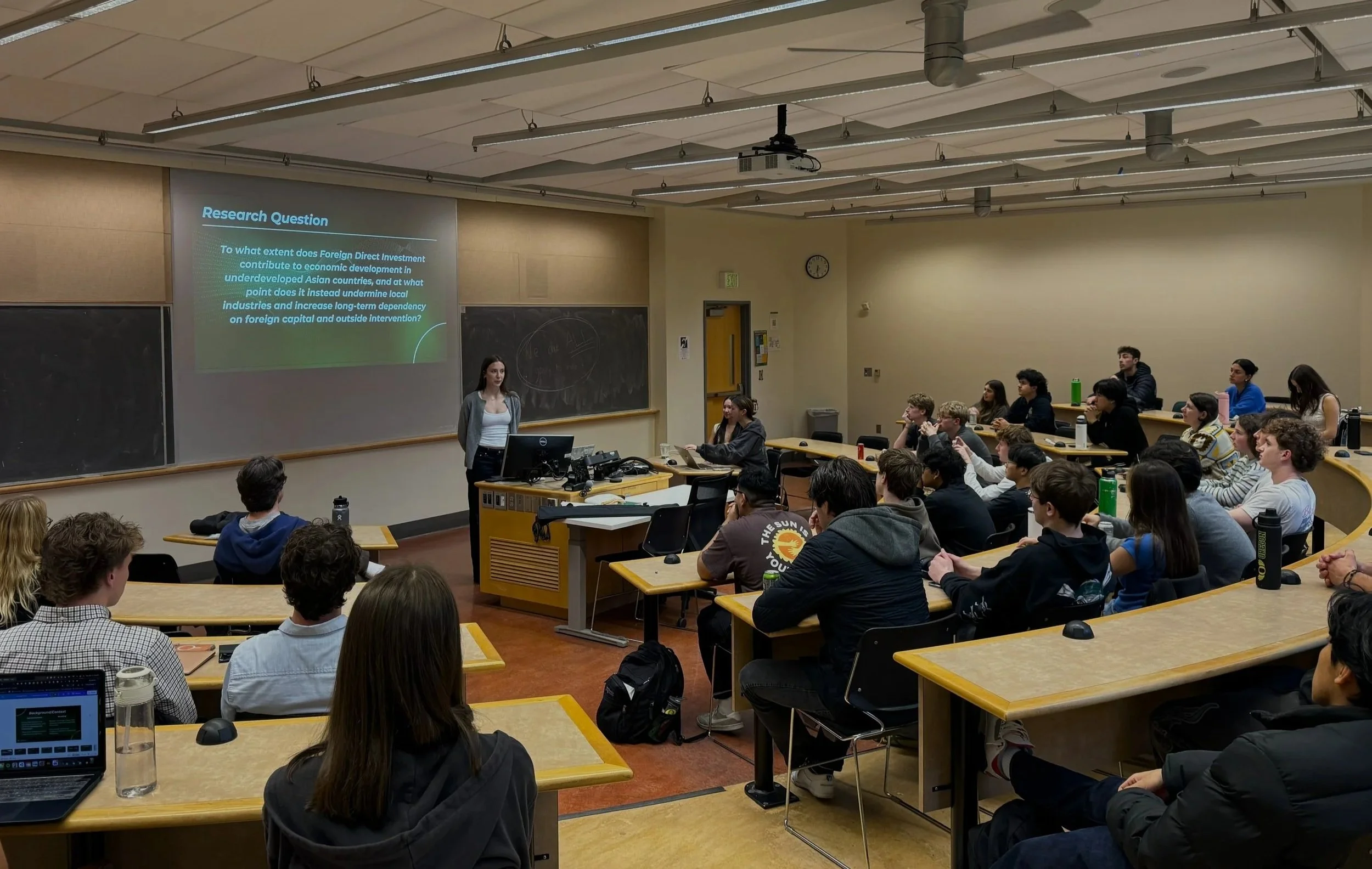
The division delivers structured research design, academic level sourcing, original insight development, clear written and visual communication, and public or company facing publication.
Designed for students interested in strategic, financial, operational, or geopolitical analysis, the division upholds high standards of rigor, accountability, and intellectual curiosity.
Research Division
Founded in 2025, the Research Division serves as the analytical arm of IBEC, created to provide deeper engagement beyond general meetings and networking events.
While IBEC emphasizes community and professional development, the Research Division centers on structured research, market analysis, and long form insight development.
Under the guidance of a Project Manager, each analyst develops and executes an independent project throughout the term, exploring topics across global industries, economic trends, culture, strategy, and geopolitics.
Why Get Involved
Joining the Research Department offers a structured, high-impact opportunity to deepen both analytical and professional capabilities in a rigorous yet supportive environment.
Develop technical capabilities through market research, in-depth analysis, data synthesis, and the application of business theories and frameworks.
Sharpen professional skills essential to high-performance environments, including structured thinking, adaptive communication, deadline accountability, and confident public speaking.
Build your resume with compelling interview stories and writing samples that showcase your ability to transform complex data into digestible insights.
The Research Division provides experience that closely resembles independent academic research, think tank analysis, or industry white paper development. Check it out in detail below:
-
Each analyst selects a topic, develops a research question, conducts literature review, and produces a final academic paper with works cited.
-
Members learn how to:
Test topic feasibility before committing
Identify gaps in existing literature
Refine broad interests into focused, answerable research questions
Apply the “so what?” test to ensure significance
-
Members move beyond summarizing sources. Papers must synthesize ideas, connect competing perspectives, and introduce original analysis supported by evidence.
-
Each project is transformed into:
A polished long form research paper
A public facing article
A presentation deck
A visual social media breakdown
This process develops the ability to communicate complex ideas to both technical and general audiences.
By the end of the term, members have tangible, portfolio ready work and the confidence to discuss independent research in interviews.
Our Process
-
Weeks 1 to 3 focus on building a strong intellectual foundation.
Members:
Conduct background research
Assess topic viability
Develop a broad research question
Complete a literature review
Identify knowledge gaps in existing scholarship
Refine a specific and answerable research question
Before finalizing, each question must pass the “so what?” test to ensure relevance and significance.
Deliverables include a literature review and a finalized research question with defined scope.
-
Weeks 4, 5, and 6 focus on deep analysis.
If feasible, members:
Design and conduct primary research such as surveys or interviews
Collect meaningful data or qualitative evidence
If primary research is not viable, analysts move directly into structured drafting using secondary sources.
Members outline their paper with:
A clear thesis
Analytical body sections that synthesize sources rather than summarize
A conclusion that explains broader significance
The phase culminates in a 4 page draft reviewed by leadership for feedback.
-
Week 7 is dedicated to revision and refinement.
Members:
Strengthen argument clarity
Adjust the research question if needed
Finalize citations
Submit a 5 page completed paper with works cited
At this stage, the research must stand independently as a polished academic or professional document.
-
Weeks 8 and 9 focus on translating research into accessible formats.
Each analyst:
Publishes their paper on public platforms
Writes a shorter, audience friendly article
Designs a presentation deck
Creates visual content for social media
The term concludes with formal presentations and multi channel publication, ensuring research reaches both academic and general audiences.
Past Projects
Winter 2026 Projects
How to Apply
Our application process starts week 8 of the prior term. Applications require a resume and answering a couple supplemental questions.
Our meetings start during week 1 of the term and run throughout, with final deliverables being presented typically during week 10.
If you are interested in becoming a Research Analyst for IBEC, keep a look out for the application towards the end of the term by attending the weekly IBEC meetings and staying up to date on the MS Teams page and Instagram page.